English
 Bulgarian
 Chinese (Simplified)
 Croatian
 Czech
Czech Danish
 Dutch
Dutch Finnish
 French
 German
 Greek
Greek Hebrew
 Hindi
Hindi Indonesian
 Italian
 Japanese
 Korean
 Macedonian
 Polish
 Portuguese
 Romanian
 Russian
 Serbian
 Slovak
 Slovenian
 Spanish
 Swedish
 Thai
Thai Turkish
 Vietnamese
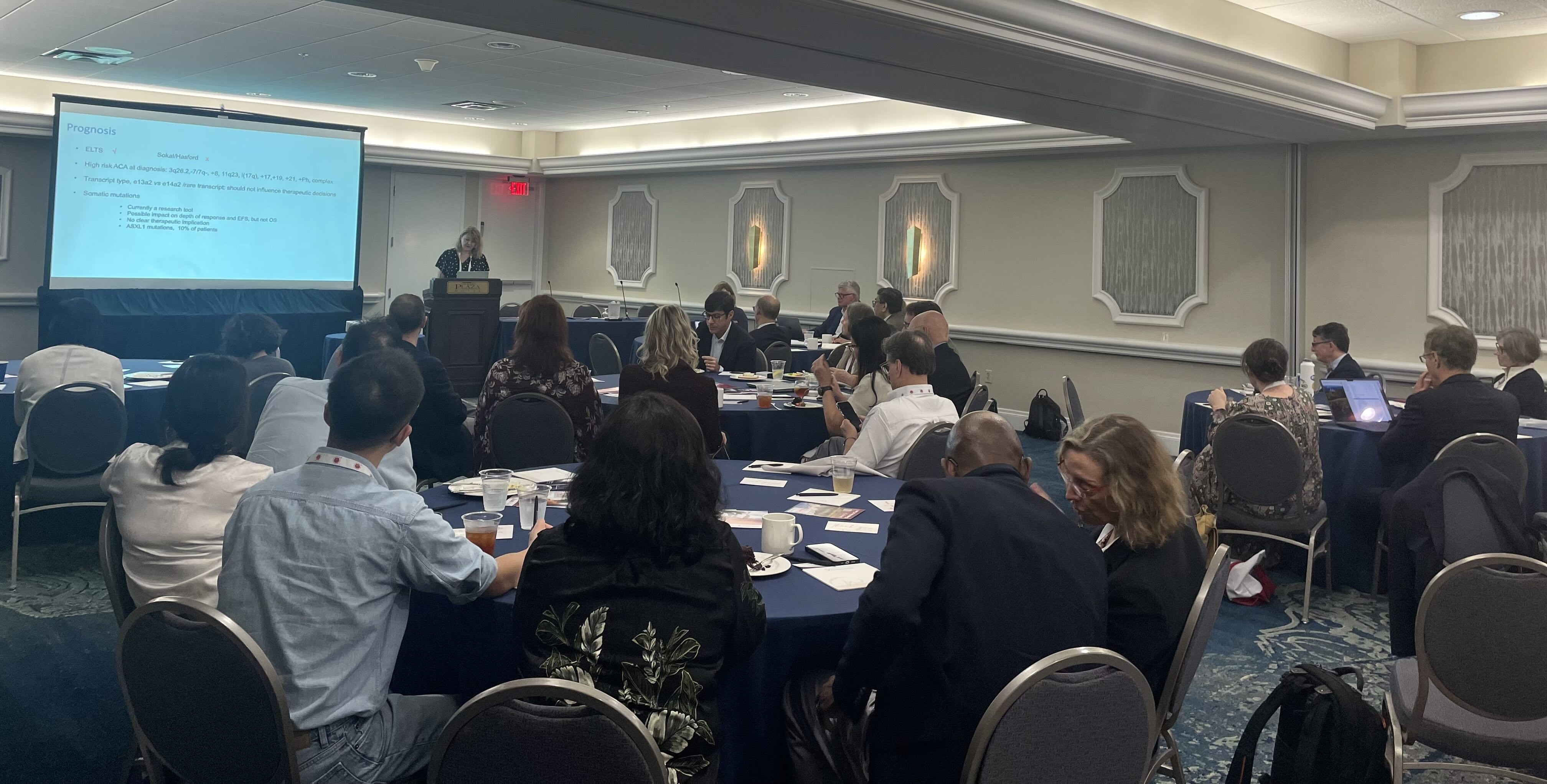 December 2025 - The iCMLf Forum at ASH 2025 brought together global leaders in CML to examine unresolved clinical controversies, emerging biological insights, and the bold scientific ambition to cure CML. As in previous years, the Forum provided a candid, interactive space where guidelines, real-world practice, and future research priorities were openly debated.
Setting the Scene: Collaboration, Innovation, and the Road Ahead
“We hear from a lot of people that CML is ‘done’ and research investment is no longer needed. But what we hear from our programs is very different.”
Nicola Evans (Chief Executive iCMLf)
Opening the meeting, Professor Andreas Hochhaus and Nicola Evans, Chief Executive of the iCMLf, reflected on the Foundation’s global mission and evolving priorities. While CML outcomes have been transformed by 25 years of TKI therapy, speakers emphasised that CML is not ‘done’. Late presentations, TFR failure, pediatric challenges, diagnostic gaps, and inequities in access, particularly in low- and middle-income countries, remain pressing realities. These lived challenges continue to shape the iCMLf’s education, research, and support programs worldwide.
ELN 2025 Recommendations: Remaining controversies?
Professor Dragana Milojkovic provided a critical appraisal of the ELN 2025 CML recommendations, focusing on areas where debate persists. Key discussion points included:
- First-line TKI selectionand the balance between deeper molecular responses, long-term toxicity, cost, and patient priorities
- Response milestones and switching thresholds, particularly the interpretation of BCR::ABL1 levels between 1–10% at 12 months
- TFR: who should be considered, when to stop, how intensively to monitor, and how prior resistance should influence decision-making
- Global relevance of guidelines, with robust discussion on how recommendations translate (or fail to translate) to settings with limited access to drugs, monitoring, and mutation testing
A central theme was the tension between evidence-based guidance and real-world constraints, prompting calls for complementary, context-specific guidance for resource-limited settings.
ASXL1 and beyond: Defining clinical impact
“At the moment, genomic findings inform risk awareness rather than direct treatment decisions — but that is likely to change.” Professor Susan Branford
In a detailed scientific update, Professor Susan Branford reviewed growing evidence on ASXL1 and other somatic mutations in CML. Drawing on data from international cohorts, the iCMLf Genomics Alliance, and prospective trials, she highlighted that:
- Pathogenic variants, particularly ASXL1, are present in ~7–12% of patients at diagnosis
- These mutations are associated with higher rates of treatment failure and acquisition of BCR::ABL1 mutations, even with more potent TKIs
- Most ASXL1 mutations become undetectable with therapy, but persistentmutations may signal higher risk
- At present, genomic findings inform risk awareness and monitoring, but do not yet direct routine treatment decisions
The discussion underscored the urgent need for larger datasets, longitudinal analyses, and functional studies to determine how genomics should ultimately shape frontline and salvage strategies.
The iCMLf Cure Consortium: A global ambition
“This is about shifting from managing CML indefinitely to asking how we finally eliminate leukemic stem cell persistence.” Professor Tiong Ong
The Forum concluded with the first public presentation of the iCMLf Cure Consortium, led by Professors Ravi Bhatia and Tiong Ong, with introduction by Nicola Evans. The Consortium sets out an ambitious, collaborative goal: to make durable, treatment-free cure achievable for the vast majority of people living with CML.
Key elements include:
- A coordinated global effort to understand and eliminate leukemic stem cell persistence, the central barrier to cure
- Integration of basic biology, advanced genomics, model systems, and clinical trial data
- A deliberately inclusive framework, inviting contributions from international centres, multidisciplinary experts, and patient communities
The presentation sparked strong engagement from the audience, with discussion focusing on definitions of cure, feasibility timelines, equitable global participation, and how collaborative science can accelerate progress beyond what fragmented efforts can achieve.
The iCMLf Forum at ASH once again demonstrated the Foundation’s unique role as a convener of open discussion, global collaboration, and forward-looking science. By bringing unresolved controversies into the open and pairing them with bold, coordinated research initiatives, the Forum reaffirmed a shared commitment: ensuring that scientific progress translates into better, more equitable outcomes for people living with CML worldwide.