English
 Bulgarian
 Chinese (Simplified)
 Croatian
 Czech
Czech Danish
 Dutch
Dutch Finnish
 French
 German
 Greek
Greek Hebrew
 Hindi
Hindi Indonesian
 Italian
 Japanese
 Korean
 Macedonian
 Polish
 Portuguese
 Romanian
 Russian
 Serbian
 Slovak
 Slovenian
 Spanish
 Swedish
 Thai
Thai Turkish
 Vietnamese
Our CEO, Nicola, reflects on this year’s Climb for a Cure and what it truly represents.
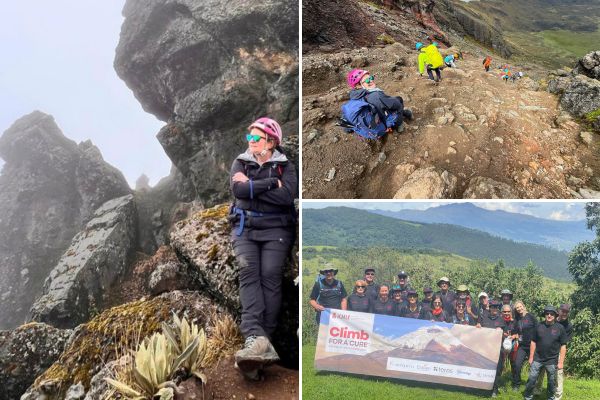
There is a moment, about five hours into the ascent of Ruminahui Volcano, when the summit is visible but feels entirely out of reach. The path is steep and loose underfoot, the air thin at over 4,500 metres. I was moving slowly, digging deep for every step. Around me, 18 other climbers; physicians, patients, researchers, industry colleagues, and supporters from across the world, were doing the same. Some were struggling. Some were already celebrating. I was somewhere in between, focused entirely on not stopping.
When I reached the top, almost stumbling over the final rock, others were smiling and embracing. I sat down, crossed my arms and stared into the distance. That photo tells the truth: this second summit broke me a little. And I wouldn't change a thing about it.
This was my third Climb for a Cure; Kilimanjaro in 2019, Annapurna Base Camp in 2023 and now Ecuador. I come back to the Climb because the challenge matters, the cause matters, and the community that gathers around both matters more than I can easily explain. Nineteen people from different countries, different disciplines, and different walks of life spent a week sleeping in tents, trekking across extraordinary Andean landscapes, eating simple camp cooked food, and pushing through at altitude sickness and discomfort side by side. That doesn't happen unless people genuinely believe in something.
Yunus, who is living with CML, has joined every one of our three climbs. There is something profound about sharing a mountain with a 22 year old whose daily life holds a challenge none of us on that trek can fully imagine. He keeps showing up. He keeps climbing. And in doing so, he reminds every one of us, without a word needing to be said, exactly what we are working toward.
The climbs are designed to be hard. That is intentional. A patient's journey with CML - the diagnosis, the treatment, the uncertainty, the daily weight of it - is not easy. We take on a physical challenge as a small, imperfect attempt to walk in the direction of that experience. We sweat, we struggle, we dig deep. But then we go home. That asymmetry is always present. During training, on the early mornings when my boots fall apart or blisters form on blisters or I miss my daughter’s singing performance, I think of the families I know through iCMLf's work - parents trying to get medication for their children, patients facing a diagnosis without the resources that should exist. That thought reorients everything.
On the descent from Ruminahui, someone said the words that became my quiet mantra of the rest of the trip: down is good. The relief was physical and immediate. But there is something else in those words, a reminder that after the hardest part, there is a way forward. That is what I believe about CML too.
We are living in a moment of genuine possibility. A cure for CML is not wishful thinking, it is a scientific horizon that the iCMLf community is actively working toward. The willingness is there. The collaboration is there. Nineteen people just proved, on the side of a volcano in Ecuador, that when this community commits to something, it shows up fully. Physicians and patients, researchers and supporters, all of us, together. That is not a small thing. That is everything.
We get to go home, and leave the mountain behind. Let's make sure our work means that one day, every person with CML can leave their mountain behind too.
Find out more at: https://climb-for-a-cure.raiselysite.com/