English
 Bulgarian
 Chinese (Simplified)
 Croatian
 Czech
Czech Danish
 Dutch
Dutch Finnish
 French
 German
 Greek
Greek Hebrew
 Hindi
Hindi Indonesian
 Italian
 Japanese
 Korean
 Macedonian
 Polish
 Portuguese
 Romanian
 Russian
 Serbian
 Slovak
 Slovenian
 Spanish
 Swedish
 Thai
Thai Turkish
 Vietnamese
News
CML Without Borders: A Forum in the Andes
The iCMLf brings global expertise to Ecuador in collaboration with the Sociedad Ecuatoriana de Hematología
On February 27th, the iCMLf convened a one-day forum at the Hospital de Especialidades Eugenio Espejo in Quito, Ecuador, bringing together leading CML experts from across the globe. Held in collaboration with the Sociedad Ecuatoriana de Hematología, the iCMLf Forum CML Without Borders: A Dialogue from the Andes drew international and Ecuadorian clinicians, laboratory specialists, and researchers together with a shared focus on advancing the treatment of CML in Ecuador and across Latin America.
Down is Good - iCMLf Climb for a Cure
Our CEO, Nicola, reflects on this year’s Climb for a Cure and what it truly represents.
There is a moment, about five hours into the ascent of Ruminahui Volcano, when the summit is visible but feels entirely out of reach. The path is steep and loose underfoot, the air thin at over 4,500 metres. I was moving slowly, digging deep for every step. Around me, 18 other climbers; physicians, patients, researchers, industry colleagues, and supporters from across the world, were doing the same. Some were struggling. Some were already celebrating. I was somewhere in between, focused entirely on not stopping.
The iCMLf Cure Consortium: Driving the Cure of CML - An invitation for global collaboration
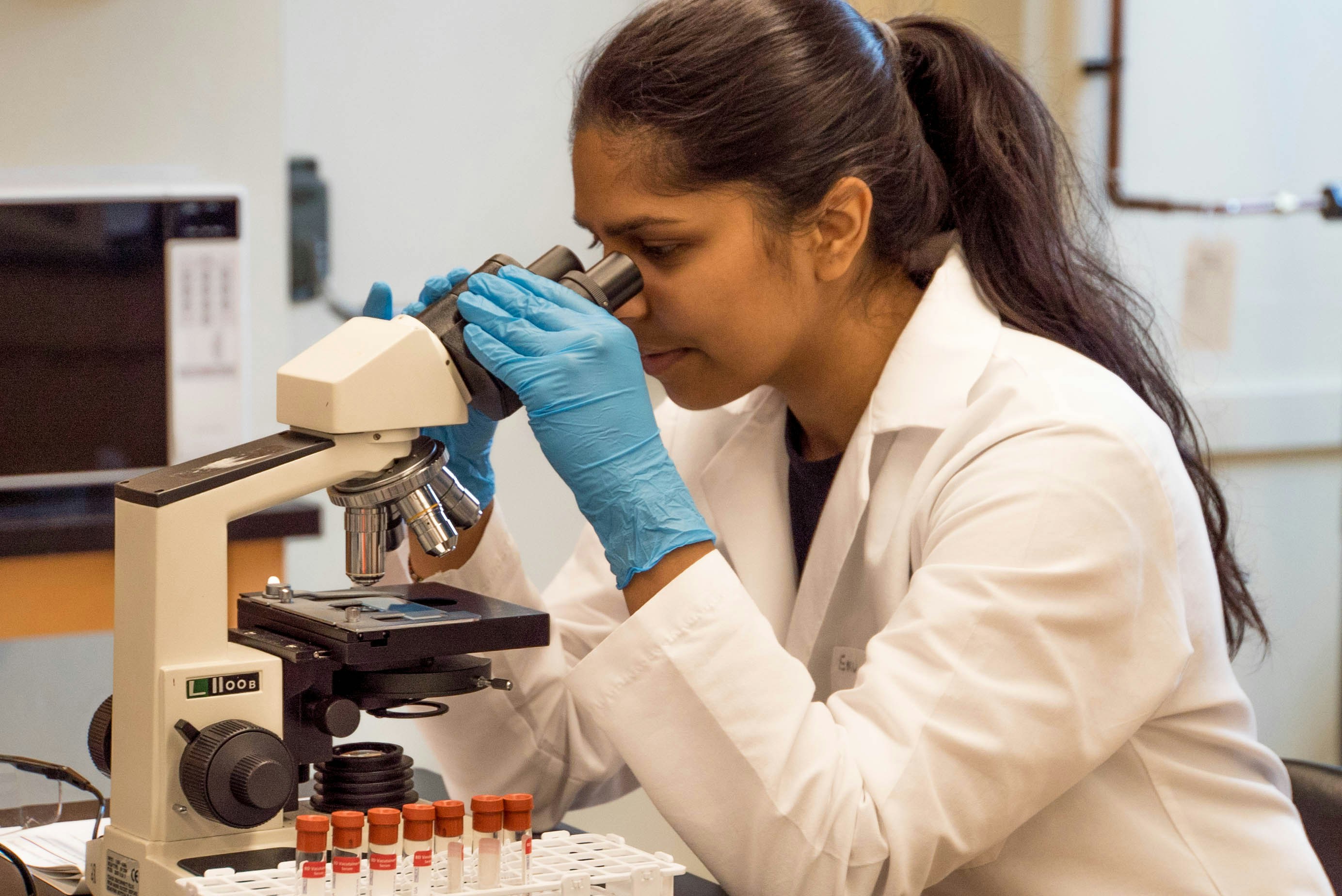
February 2026 - The iCMLf is seeking collaborators to join the iCMLf Cure Consortium (iC3), a global, multidisciplinary initiative focused on achieving a cure for CML.
Background
Over the past two decades, tyrosine kinase inhibitors have transformed CML into a manageable disease. Yet for most patients, cure remains elusive. Nearly half of those who achieve deep molecular response relapse after stopping therapy, reflecting the persistence of leukemia stem cells and their supportive microenvironment. Lifelong treatment carries clinical, psychological, and economic burdens and remains inaccessible or unsustainable in many parts of the world. A cure, therefore, is not only a scientific goal, but a global equity imperative.
Global CML Community to Scale Ecuador’s Volcanoes in the iCMLf Climb for a Cure 2026
Physicians, patients and researchers unite at 4,600 metres to advance global CML care
February 26th 2026 – The International CML Foundation (iCMLf) this week launches the iCMLf Climb for a Cure 2026, its flagship global fundraising initiative bringing together physicians, researchers, people living with chronic myeloid leukemia (CML), and supporters for an eight-day high-altitude expedition through Ecuador’s Avenue of the Volcanoes.
Nineteen members of the global CML community will trek to altitudes exceeding 4,600 metres in the foothills of Cotopaxi, one of the world’s highest active volcanoes. The expedition symbolises the resilience, preparation and long-term commitment required to advance CML care and accelerate progress toward a cure.
Reminder: Call for iCMLf Prize nominations – Submission deadline January 31
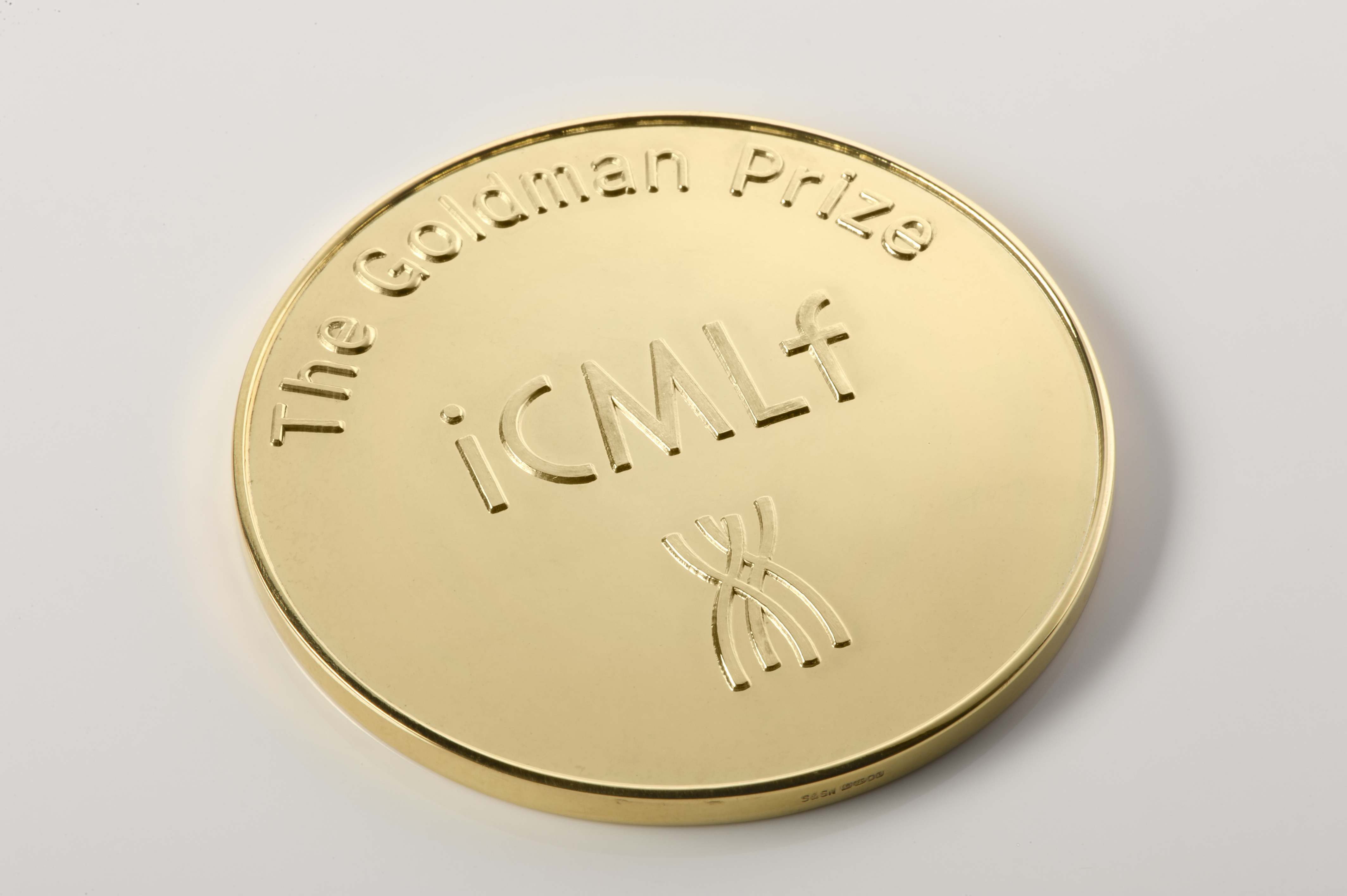 January 2026 - There is still time to help spotlight excellence in CML research, care, and global access by nominating outstanding individuals for the 2026 iCMLf Prizes.
Each year, these prizes honour visionary scientists, clinicians, and advocates whose lifetime contributions have shaped the global CML landscape. If you have not yet done so, we invite you to submit your nominations for one of the three 2026 iCMLf Prizes:
🥇 The Rowley Prize – For exceptional scientific achievements that have transformed our understanding of CML biology.
🥇 The Goldman Prize – Recognising excellence in advancing clinical practice and improving outcomes for CML patients.
🥇 The iCMLf Prize – Celebrating outstanding efforts to overcome CML treatment challenges in low- and middle-income countries.
Nominations for the 2026 Prizes are closed.
REMINDER: Join us on Tuesday Jan 20th, 14.00 CET for CML Highlights of ASH 2025
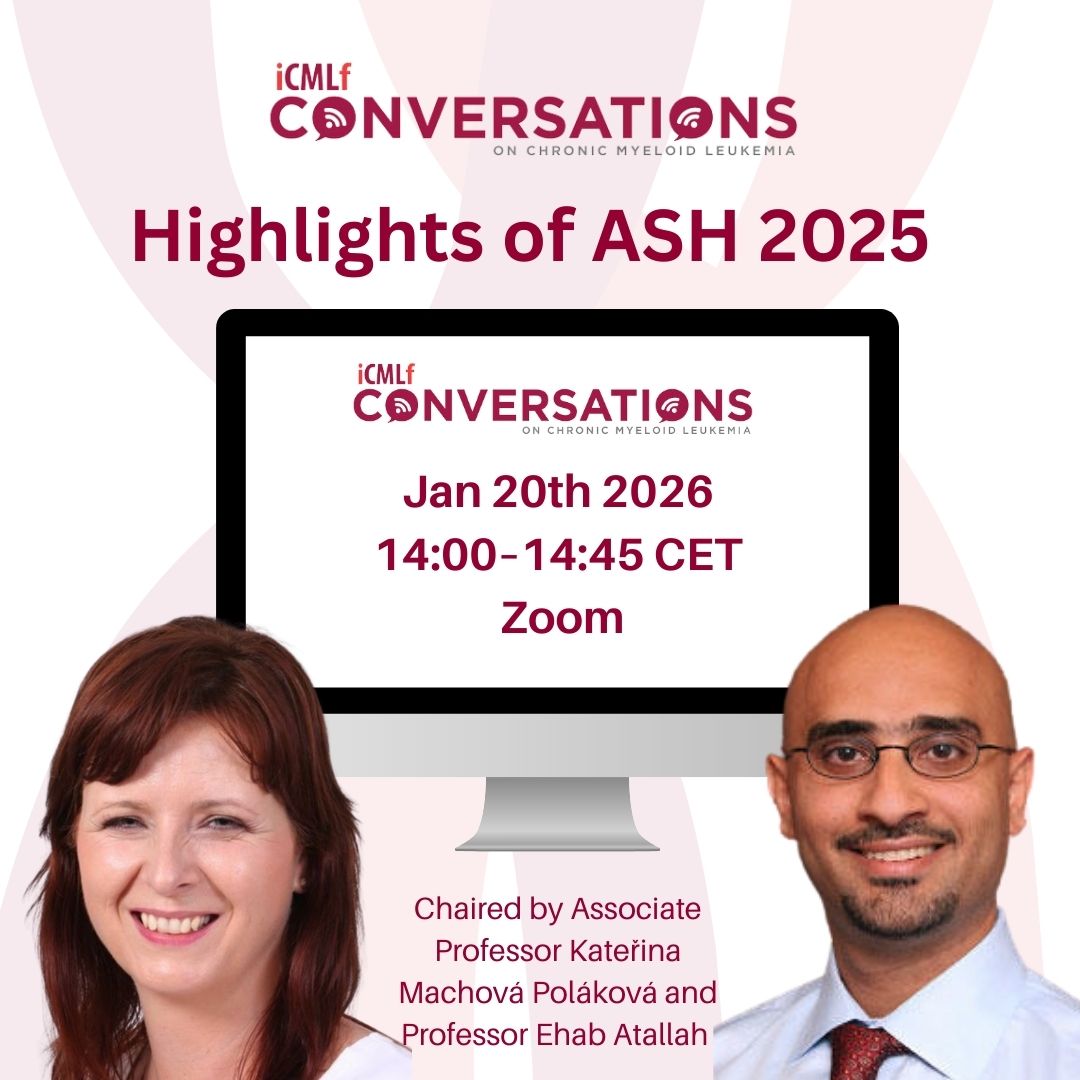 January 2026 - This is a friendly reminder to join us for the ‘CML Highlights of ASH 2025’ webinar, the first iCMLf Conversation of 2026, taking place on:
📅 Tuesday, January 20th, 2026
🕐 14:00 Central European Time (CET)
📍 Live webinar on Zoom (45 mins)
Click here for more information and times in other time zones.
If you have not registered yet, you can secure your place here.
Once registered, you’ll receive your Zoom log-in details via Zoom.